Is E120 halal?
Carmine · Cochineal · Carminic acid
Doubtful in food, by default. Carmine is an insect colour and authorities genuinely split on it. Indonesia's MUI rules it permissible, so the answer depends on which authority you follow.
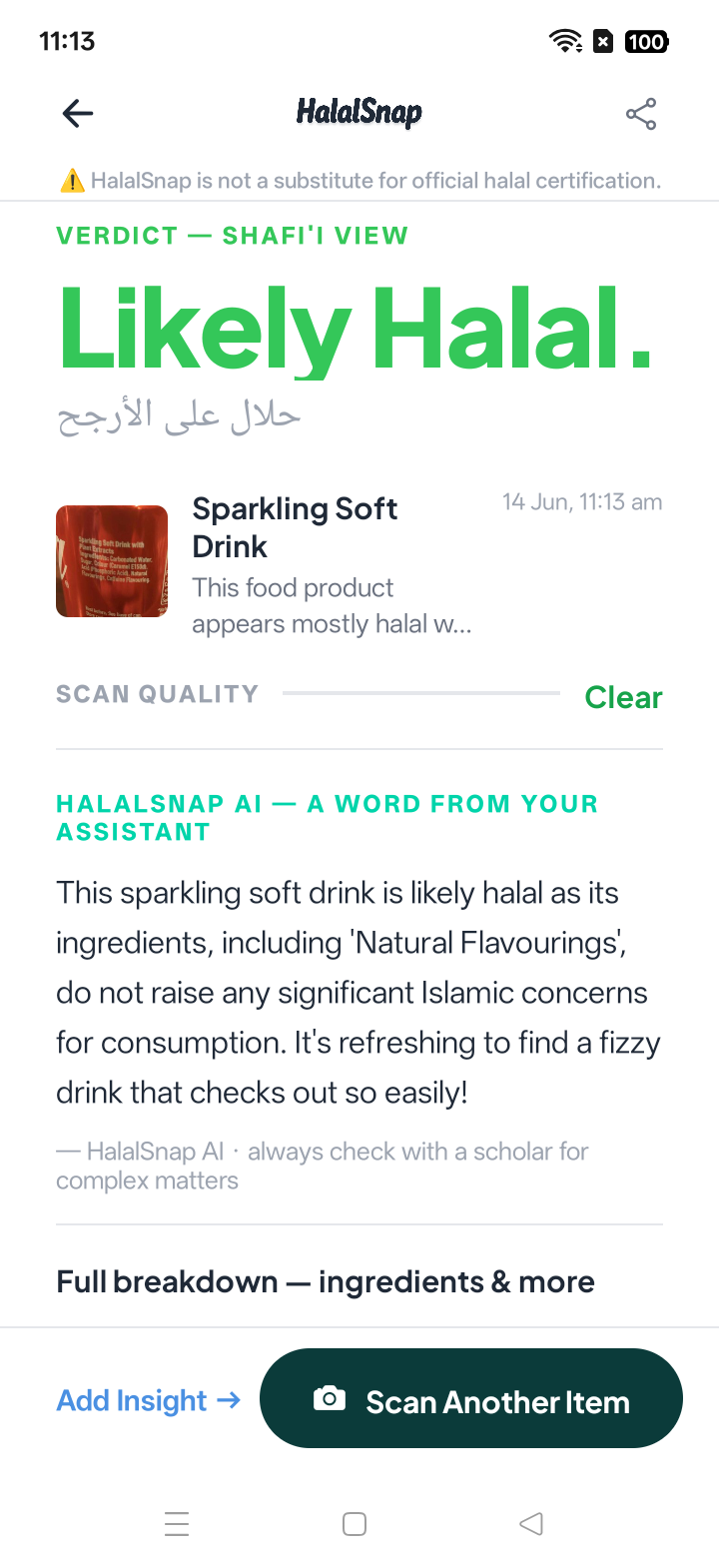
Holding the pack? One E-code is one line of the label. Scan the whole pack and get one answer for your mazhab.
What E120 is
Carmine, also called cochineal, is a red colour made from the dried bodies of the cochineal insect.
By mazhab
What a HalalSnap scan concludes when the pack does not settle the question, under each school setting in the app.
| School | Answer | Why |
|---|---|---|
| Hanafi | Doubtful in food | The market authority is applied first. With no market, food defaults to doubtful.R-ADD-01 |
| Shafi'i | Doubtful in food | The market authority is applied first. With no market, food defaults to doubtful.R-ADD-01 |
| Maliki | Doubtful in food | Maliki methodology is the most tolerant of insects, and a scan explains that. The default verdict in food is still doubtful.R-ADD-01 |
| Hanbali | Doubtful in food | The market authority is applied first. With no market, food defaults to doubtful.R-ADD-01 |
| General / mixed | Doubtful in food | The market authority is applied first. With no market, food defaults to doubtful.R-ADD-01 |
By market
HalalSnap names an authority only inside that authority's own country. Where it holds no published list, it says so.
| Market | Answer | Source and notes |
|---|---|---|
| Singapore (MUIS) | Not flagged in the 2016 list | The MUIS Food Additive Listing does not mark E120 syubhah. HalalSnap holds no MUIS fatwa on carmine, so a scan does not name MUIS for it. |
| Malaysia (JAKIM) | No JAKIM position held | HalalSnap holds no JAKIM ruling on carmine. A scan applies the default: doubtful in food. |
| Indonesia (MUI / BPJPH) | Permissible (MUI) | MUI Fatwa 33 of 2011 rules cochineal colouring halal as long as it is beneficial and not harmful.MUI Fatwa No. 33 of 2011 on cochineal colouring, 10 Aug 2011 |
| Elsewhere or market unknown | Doubtful in food | With no market authority to anchor to, a scan says doubtful in food. |
Why it depends
Carmine comes from an insect, so the question is not its source but whether an insect colour may be eaten. Authorities genuinely split on that. Indonesia's MUI has ruled it permissible. Others treat insect-derived colour as impermissible or doubtful. With no market to anchor to, a scan says doubtful in food. In cosmetics the rule is gentler, with a note for lip products because some is swallowed.
How to check the pack
- A halal mark printed on the pack. A different red colour, such as beetroot red (E162) or paprika extract (E160c), avoids the question.
- Look for a recognised halal mark (JAKIM, MUI/BPJPH, MUIS or another reputable certifier) on the pack in your hand. A mark you can see settles it for the whole product.R-CERT-01
- A vegan or vegetarian mark settles animal-source questions.R-CERT-05
- A kosher mark rules out pork only. It does not settle the halal question on its own.R-CERT-04
- Still unsure? Ask the maker which source they use, or choose a certified alternative.
Questions people ask
What is E120?
Carmine, also called cochineal, is a red colour made from the dried bodies of the cochineal insect.
Is E120 halal or haram?
Doubtful in food, by default. Carmine is an insect colour and authorities genuinely split on it. Indonesia's MUI rules it permissible, so the answer depends on which authority you follow.
Is E120 halal in Singapore, Malaysia and Indonesia?
Singapore: The MUIS Food Additive Listing does not mark E120 syubhah. HalalSnap holds no MUIS fatwa on carmine, so a scan does not name MUIS for it. Malaysia: HalalSnap holds no JAKIM ruling on carmine. A scan applies the default: doubtful in food. Indonesia: MUI Fatwa 33 of 2011 rules cochineal colouring halal as long as it is beneficial and not harmful.
Does my mazhab change the answer for E120?
How each school setting in HalalSnap reads it: Hanafi: doubtful in food; Shafi'i: doubtful in food; Maliki: doubtful in food; Hanbali: doubtful in food; General: doubtful in food. HalalSnap applies the school you choose in the app.
How can I tell whether the E120 in my product is halal?
A halal mark printed on the pack. A different red colour, such as beetroot red (E162) or paprika extract (E160c), avoids the question. HalalSnap does this for you: scan the whole pack and it reads every ingredient, looks for a halal or vegan mark, and gives one answer for your mazhab.
Sources
- HalalSnap ruling table v1.4, rule R-ADD-01 20 Aug 2026
- HalalSnap ruling table v1.4, rule R-ADD-02 20 Aug 2026
- MUI Fatwa No. 33 of 2011 on cochineal colouring (Indonesia) 10 Aug 2011
- MUIS Food Additive Listing (Singapore). Syubhah flag only 13 Sep 2016
Review status: Open question for a scholar. R-ADD-02 (carmine in cosmetics) is the one rule the ruling table leaves deliberately unpinned pending a scholar's decision. Rule ids refer to HalalSnap's ruling table, the decision table every scan follows. The MUIS listing is reproduced as a factual flag only; it is a certifier verification list for Singapore, dated 2016, not a consumer fatwa.
Related ingredients
One E-code is one line of the label.
Scan the whole pack and get one answer for your mazhab. HalalSnap reads every ingredient, looks for a halal or vegan mark, and shows which line decides it.
- Every ingredient on the pack, not one code at a time
- Set to your mazhab, with the reasoning shown
- Food, drinks, supplements, cosmetics and toothpaste
- Free to download, with weekly community credits