Is E920 halal?
L-Cysteine hydrochloride
A bare "E920" on a label is doubtful until the pack shows where it came from. What settles it: a halal mark printed on the pack, a vegan or vegetarian mark, or a declared synthetic or microbial source.
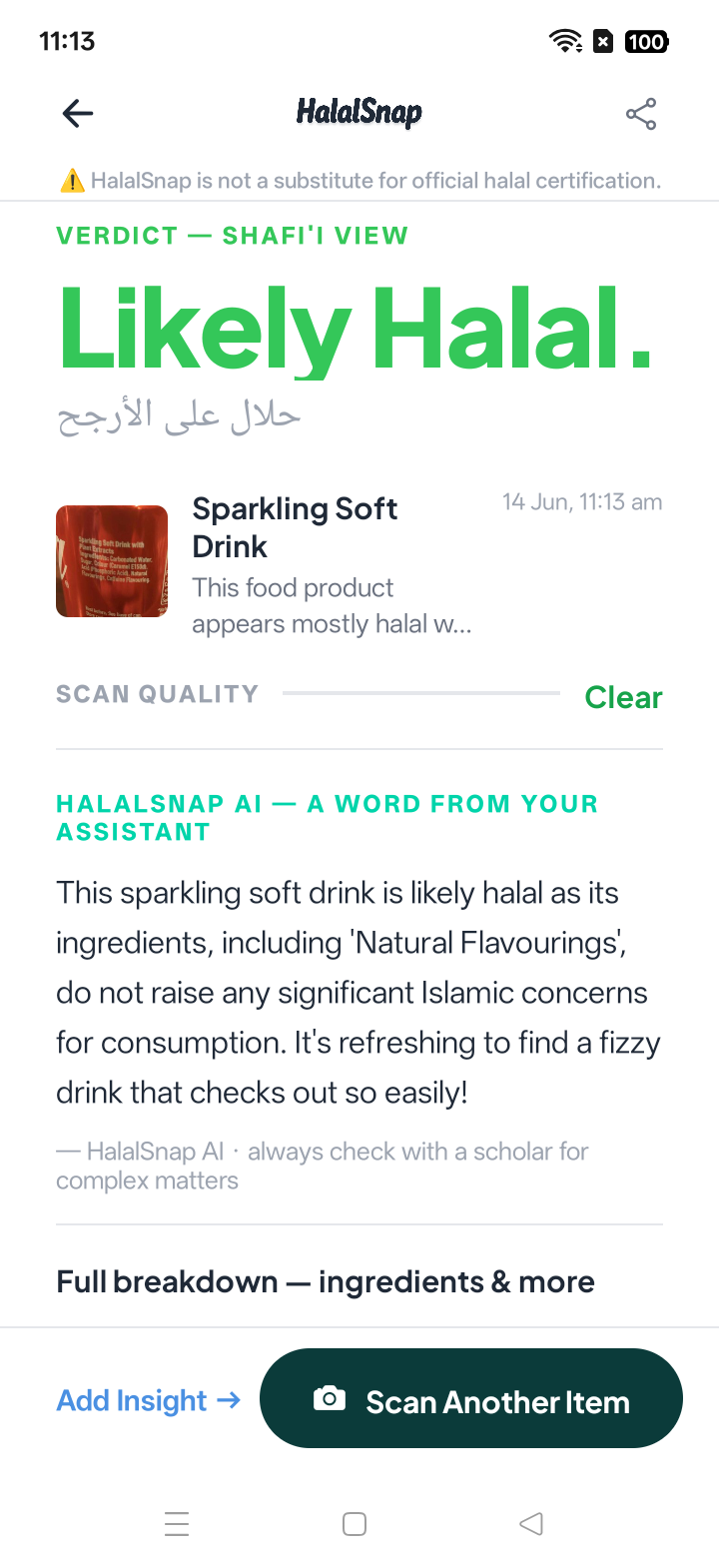
Holding the pack? One E-code is one line of the label. Scan the whole pack and get one answer for your mazhab.
What E920 is
L-cysteine is an amino acid used to soften dough in bread. It can be made from feathers, by fermentation or synthetically. Historically, hair was also a source.
By mazhab
What a HalalSnap scan concludes when the pack does not settle the question, under each school setting in the app.
| School | Answer | Why |
|---|---|---|
| Hanafi | Doubtful until the source is shown | The open question is where it came from, not a difference between the schools, so HalalSnap gives the same answer under every school setting.R-ADD-06 |
| Shafi'i | Doubtful until the source is shown | |
| Maliki | Doubtful until the source is shown | |
| Hanbali | Doubtful until the source is shown | |
| General / mixed | Doubtful until the source is shown |
By market
HalalSnap names an authority only inside that authority's own country. Where it holds no published list, it says so.
| Market | Answer | Source and notes |
|---|---|---|
| Singapore (MUIS) | Listed syubhah (MUIS, 2016) | MUIS marks E920 syubhah in its 2016 Food Additive Listing. A scan in Singapore gives the same doubtful answer and names MUIS as the source. |
| Malaysia (JAKIM) | Doubtful until the source is shown | HalalSnap holds no JAKIM additive list, so a scan gives the same answer and names no authority for it. |
| Indonesia (MUI / BPJPH) | Doubtful until the source is shown | HalalSnap holds no MUI additive list, so a scan gives the same answer and names no authority for it. |
| Elsewhere or market unknown | Doubtful until the source is shown | The same answer in every market. Only the authority a scan names changes with where you are. |
Why it depends
L-cysteine can be made from feathers, by fermentation or synthetically. Human-hair-derived L-cysteine is rejected by halal bodies and feather-derived is generally accepted, so the source genuinely decides it. A bakery label does not say which.
How to check the pack
- A halal mark printed on the pack, a vegan or vegetarian mark, or a declared synthetic or microbial source.
- Look for a recognised halal mark (JAKIM, MUI/BPJPH, MUIS or another reputable certifier) on the pack in your hand. A mark you can see settles it for the whole product.R-CERT-01
- A vegan or vegetarian mark settles animal-source questions.R-CERT-05
- A kosher mark rules out pork only. It does not settle the halal question on its own.R-CERT-04
- The source has to sit right next to the additive. "Palm oil" earlier in the list does not tell you where a later bare emulsifier came from.R-GUARD-01
- Still unsure? Ask the maker which source they use, or choose a certified alternative.
Questions people ask
What is E920?
L-cysteine is an amino acid used to soften dough in bread. It can be made from feathers, by fermentation or synthetically. Historically, hair was also a source.
Is E920 halal or haram?
A bare "E920" on a label is doubtful until the pack shows where it came from. What settles it: a halal mark printed on the pack, a vegan or vegetarian mark, or a declared synthetic or microbial source.
Is E920 halal in Singapore, Malaysia and Indonesia?
Singapore: MUIS marks E920 syubhah in its 2016 Food Additive Listing. A scan in Singapore gives the same doubtful answer and names MUIS as the source. Malaysia: HalalSnap holds no JAKIM additive list, so a scan gives the same answer and names no authority for it. Indonesia: HalalSnap holds no MUI additive list, so a scan gives the same answer and names no authority for it.
Does my mazhab change the answer for E920?
No. HalalSnap gives the same answer for E920 under every school setting, because the question is where it came from.
How can I tell whether the E920 in my product is halal?
A halal mark printed on the pack, a vegan or vegetarian mark, or a declared synthetic or microbial source. HalalSnap does this for you: scan the whole pack and it reads every ingredient, looks for a halal or vegan mark, and gives one answer for your mazhab.
Sources
- HalalSnap ruling table v1.4, rule R-ADD-06 21 Aug 2026
- HalalSnap scan engine: source-flagged additive list, applied on every scan 22 Aug 2026
- MUIS Food Additive Listing (Singapore). Syubhah flag only 13 Sep 2016
Review status: Not yet reviewed by a scholar. Rule ids refer to HalalSnap's ruling table, the decision table every scan follows. The MUIS listing is reproduced as a factual flag only; it is a certifier verification list for Singapore, dated 2016, not a consumer fatwa.
Related ingredients
All glazing agents, gases and flour treatment · Search every E-number and ingredient
One E-code is one line of the label.
Scan the whole pack and get one answer for your mazhab. HalalSnap reads every ingredient, looks for a halal or vegan mark, and shows which line decides it.
- Every ingredient on the pack, not one code at a time
- Set to your mazhab, with the reasoning shown
- Food, drinks, supplements, cosmetics and toothpaste
- Free to download, with weekly community credits